Pages

Showing posts with label fitness. Show all posts

Thursday, June 10, 2010

Body Composition: What Are You Made Of?


The human body is composed of many parts making up a persons total body weight – the number you see on the scale.  This number however doesn’t show the entire picture.  Body composition refers to the different components that make up a persons total weight.  These components include lean weight – which includes muscles, bone, organs and water – and body fat.  Body composition is expressed as a percent of body fat mass and percent of lean body mass.  These numbers help to paint a more accurate picture.  Measuring body fat is a more reliable measurement than body mass index, which was discussed previously.

The chart below shows body fat percentage categories for women and men:


There are several methods available to calculate body fat percentages.  Some of the more popular ones include:  skin-fold test, bioelectrical impedance and underwater weighing.

The skin-fold test is by far the easiest and cheapest method available to determine body fat levels.  It is performed by measuring skin-fold thickness – a measure of fat under the skin – at specific locations on the body.  When performed properly, it can be up to 98% accurate. 

Available on the market today are scales that not only measure body weight, but take it one step further and measure body fat.  These scales use what is called bioelectrical impedance to analyze the tissue in the body.  A low-level, safe, electrical current travels through the body – quickly through the lean tissue and more slowly through fat tissue –which allows a calculation of fat and lean mass.  While there are many factors that can affect the scale’s readings including hydration levels and food intake, if you follow the directions and take the reading under similar conditions, you will obtain the best results.

Underwater weighing is by far the most accurate way to measure body fat.  It is also the most cumbersome and least viable option for most people.  It involves being weighed underwater and requires one to be completely submerged for a few seconds.

Wednesday, June 9, 2010

Time to Throw Out the Scale


Bathroom scales are worthless.  Beyond that, they can be detrimental to your emotional well-being and weight loss efforts.  Unfortunately, if you are like most people, you tend to get caught up with the number on your scale, the flashing digits that appear, seconds after you stand on it.  The number holds a power over you and can change your mood instantly.  That number however doesn’t show the whole picture and can fluctuate from day to day based on a variety of factors.

If you want to measure your success on a weight loss or fitness program, there are better ways than the scale.  These might include:

Body fat percent – The weight on the scale gives you a number – total body weight; but without knowing how much of that number corresponds to metabolically active lean muscle tissue versus fat, it is useless.   

Tape measure - Take your measurements when you begin a new program and record them once a month to monitor your progress.  This will be a better indicator than the number on a scale.

How your clothes fit – Do you have a pair of jeans, or favorite top sitting in the back of your closet that you would love to get into again?  Use it to measure your progress.

The mirror – seeing is believing.  If you can see in the mirror changes that are taking place, if people are telling you they can see a difference, believe them. 

If you feel you must weigh yourself, do so at most once a week.  But stop obsessing over the number on the scale and be sure not to let it affect your motivation, goals or weight loss efforts.  If you are feeling better, sleeping better and have more energy, these are far better indicators than what a number on the scale represents.   

Have you found yourself obsessing over the number on the scale?  Do you find it to be a motivating or discouraging tool?

Tuesday, June 8, 2010

What is Body Mass Index (BMI)?


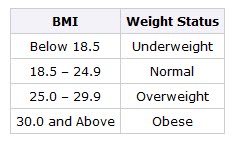
If you have been struggling to lose weight, researching general fitness or trying to improve your health, you have probably heard the term BMI or Body Mass Index thrown around.  What is Body Mass Index (BMI)?  Body Mass Index is a measure, based on an individual’s weight and height, used to determine whether or not someone is at a healthy weight range.  It is derived at by dividing your weight in pounds by your height in inches squared and multiplying that by 703.  So, how is this number interpreted?  The chart below shows the BMI ranges with the associated weight categories:


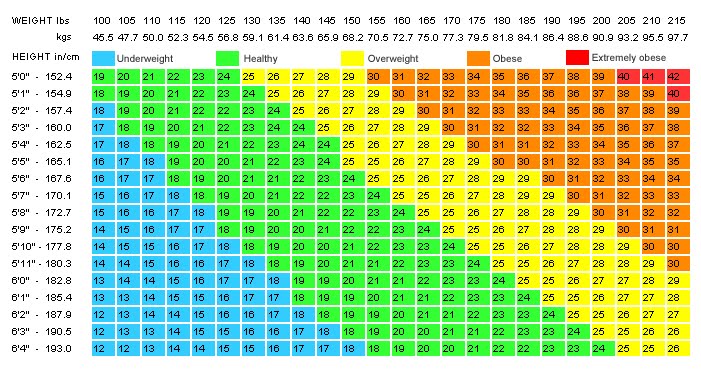
Don’t have a calculator handy?  Use the following chart below to determine your BMI.  Find your height in the vertical column and your weight in the horizontal column, your BMI can be found where these two numbers meet – along with the associated weight status.


Is BMI a reliable measure?  The problem with using this measurement is it tends to be inaccurate for very fit muscular individuals.  This is because the weight measurement used to calculate BMI does not distinguish between lean muscle and body fat.  So, if you have a 190 pound male who stands at 5’10” but is considerably muscular he would be classified as overweight, when in reality he is not.  However, for most people, BMI is a fairly reliable indicator of an individual’s weight status.

Do you know your BMI?  Does it accurately depict your weight status?

Thursday, May 13, 2010

Fitness Goals: See. Write. Speak. An Exercise in Success.


Are you ready to make your fitness goals a reality?  Let’s discuss some effective techniques to make that happen because it is about more than just exercise, it is about having the right mindset.  Let’s talk about the importance of visualization, writing down your exercise goals and verbalizing them.

Visualization.  This is the act of forming a mental picture of you achieving your goal.  It is like having a mental practice session or rehearsal in your mind of the goal you expect to achieve.  The mind is a powerful tool and your body will respond in harmony with what your mind is depicting.

Writing Down Your Goals.  Equally important is the physical act of writing down your goal.  Until a goal is written down it is just a dream, a thought, idea or wish in your mind; once written down it becomes something tangible.  Goals are well defined.  It is how we will achieve these dreams.

Verbalization.  Even more important than writing down your goals, is verbalizing your goals.  Like visualization, the subconscious picks up on these verbal cues and your body in turn responds to what your mind is saying.  In addition, verbalizing your goal to others instantly creates accountability.  When you speak your goals to those around you, you create a support system that will help you to achieve your goals.

Never underestimate the power of the mind.  I read a great book recently by Tom Venuto, The Body Fat Solution.  This book is different because it is more about the psychology, emotions and social challenges of sticking with your program than the particulars of nutrition and training science.  While I wanted to get to the exercise fundamentals, he spent the majority of the book discussing the power of the mind and being in the right mindset for your exercise program in order to achieve your fitness goal.  Now I know that to be successful you need to start by getting your mind in order which is why he dedicated so much of the book to it. It’s the most important part of the fitness equation.  Interested in learning more about Tom Venuto and his programs?  Visit him at his Burn the Fat website

Wednesday, May 12, 2010

Smart Exercise Goal. Achieve Fitness Success.


You’ve made the decision to regain control of your health and well being through fitness and exercise, now is the time to set your goals. The best way to succeed is to set SMART goals.  What do I mean when I say smart?  Well, I don’t mean that your goals up until this point have been unintelligent.  SMART is an acronym for Specific, Measurable, Attainable, Relevant and Time-bound.

Specific.  This is pretty straightforward.  What is it specifically that you would like to achieve?  Your goal must not be ambiguous but should be easy to understand.  To say you want to lose weight or gain muscle as a goal is not specific enough.

Measurable.  You must be able to measure your goal so that there is no question that the outcome has been attained.  Your goal can be measured in terms of inch loss, pounds lost, clothing size change, cholesterol drop etc.

Attainable.  When setting a goal it is important that it can be realistically attained.  Take care not to make your goal too easy or too hard because both have a tendency to affect your motivation.  If you achieve an easy goal too quickly, you may be tempted to return to your old habits.  If your goal is too difficult, you risk giving up before you achieve it.

Relevant.  A relevant goal needs to be applicable to your personal needs and abilities.  While a goal of completing a triathlon is an admiral goal, it will be difficult to achieve if, perhaps, you don’t know how to swim.

Time-bound. Lastly, the goal must have and end time by which you can measure that it has been completed.

An example of a non-SMART goal may be:  I want to improve my walk time.  Now, let’s take the same goal and make it SMART:  I want to be able to walk 4 miles in 60 minutes by August 1st.  Goals can be further broken down into short-term and long term.  A long-term goal may be to lose sixty pounds in a year; this goal can be broken down into shorter term goals, such as losing fifteen pounds in three months.  Another long-term goal may be to run a marathon; a short term goal may be to run a 5k.  By setting SMART goals, whether short-term or long-term, you will be on your way to fitness success.


Tuesday, May 11, 2010

New to Exercise?


You’re Ready.  You’re Committed.  Now where do you start?  First and foremost, before starting any exercise program, a visit to the doctor may be in order.  If you have been inactive, are overweight, suffer from any ailments or are recovering from an injury, it is always best to receive clearance from your doctor first.

Next, you will want to identify your goals.  Is your goal to lose weight, gain muscle or a combination of the two?  Are you looking to lower your cholesterol, get your diabetes in check, or ensure your health for many years to come?  Or are you just looking to be active and keep up with your children or grandchildren?
Once you have established your goals, then you will want to develop a plan.  How often will you exercise?  What form of exercise will help you achieve your goals?  What time of day best fits your schedule?  The Center for Disease Control recommends a minimum of thirty minutes of moderate exercise most days of the week. If you are new to exercise, you will want to take it slow and steady.  Try starting with a few days a week, but start small with ten minutes of exercise; once your body gets acclimated to exercising, gradually increase duration, intensity or both.  Increase your exercise by a few minutes each week until you’re up to the recommended thirty minutes.

The most important thing when deciding to start an exercise program is:  Have Fun!  Pick your workouts based on your interests.  You are more likely to be successful and stick to a program if you are participating in an activity you enjoy.  Does running burn more calories than walking?  You bet.  But the walk you will take burns a heck of a lot more calories than the run you won’t do.  If you don’t like running, don’t.  If you love walking, walk.


A great start for beginners, Leslie Sansone's Walk Away the Pounds Ultimate Collection, contains four workouts on one DVD.  The workouts range from just under 20 minutes to 60 minutes covering 1-4 miles.  Each workout builds in intensity so you can grow with the workouts.  To increase the intensity one-pound hand weights can be used.  A Stretchie, resistance band, is used to incorporate strength training into the routines.  At under $10, it is a great bargain as well.